A Very Small Start
Some projects never leave you alone. Mood—my graduate school music project from Syracuse University—was one of them. It began as an experiment in digital composition, built on a primitive GarageBand setup, wrapped in hand-built packaging, and named for a synthesizer I couldn’t afford. The Moog became Mood—a linguistic shortcut that sounded clever enough at the time. But even then, it never quite fit.
Two decades later, the name finally caught up to the work.
From Mood to Polyglyphs
Naming has always been a creative obstacle course. Back in 2005, I wrote that I’d dwelled on it for weeks without arriving at anything comfortable. Mood was supposed to describe both the temperament of the music and its electronic lineage—a nod to Robert Moog’s analog legacy. But in truth, the music was more about texture and structure than emotion. It wasn’t just a mood—it was multiple languages colliding: sound, form, type, and narrative.
That collision has become Polyglyphs—a name that now spans everything I make outside of client work. It’s an umbrella for the personal, the uncommissioned, and the self-directed: music, illustration, typography, and design. This album is the first to wear the name outright.
Fish. Frog. Duck.
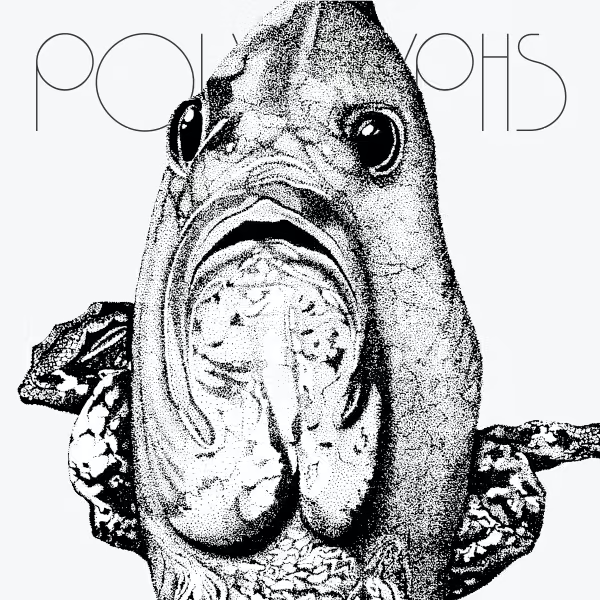
The album cover came long before the album. While still an undergraduate at Cal Poly, San Luis Obispo, I illustrated a hybrid creature—a fish with four frog’s legs and duck’s feet—for an assignment in my Illustration class: combine three animals into one fearsome critter. It became known, affectionately, as the Fish Frog Duck.
For years, the drawing sat in a flat file, escaping only as a T-shirt I printed for family one Christmas. But the image stuck with me. It felt like an emblem of everything I tend to do—hybridize, recombine, and blur boundaries. So when it came time to re-release my graduate work under a new name, the Fish Frog Duck finally had a purpose beyond nostalgia. It became the album’s face—part symbol, part totem.
Why Re-Design?
The original project was deeply personal—more autobiographical than I ever intended. It shared more than I wanted to publish officially. So this redesign exists as both reflection and refinement: a way to archive the work, recontextualize it, and document it on my own terms. The case study is the right place for that—where I can get into the nitty gritty without oversharing the sentimental stuff.
Applied, Not Composed
Back then, I described the songs as applied rather than composed. I didn’t know the first thing about songwriting, but I understood design—and to me, making music felt similar: form, balance, rhythm, restraint. Every track was designed, not written.
The album’s six songs—Small Start, Aquaplane, Wooden Waves, Carbon Nation, Nightenshade, and Bugs—were stitched together in a basement in Springfield, Missouri, between graduate deadlines, work, and family life. They sound like their environment: a little lo-fi, a little idealistic, and entirely sincere.
Polyglyphs Today
Revisiting Mood as Polyglyphs closes a loop that started twenty years ago. It connects my earliest attempts at making sound with my ongoing attempts at making meaning. It’s not a reissue. It’s a reframing—a personal archeology project that ties together school projects, early ambitions, and the restless need to keep making things.
So, here it is: Polyglyphs, the self-titled album. Built from old files, reimagined visuals, and the same stubborn energy that got it made in the first place.
As an added bonus, I’ve included the original Mood packaging design to document what Polyglyphs and Mood share—and all the places they diverge. Give it a listen and hit the Buy button below to get your own copy of Polyglyphs.